Table Of Content

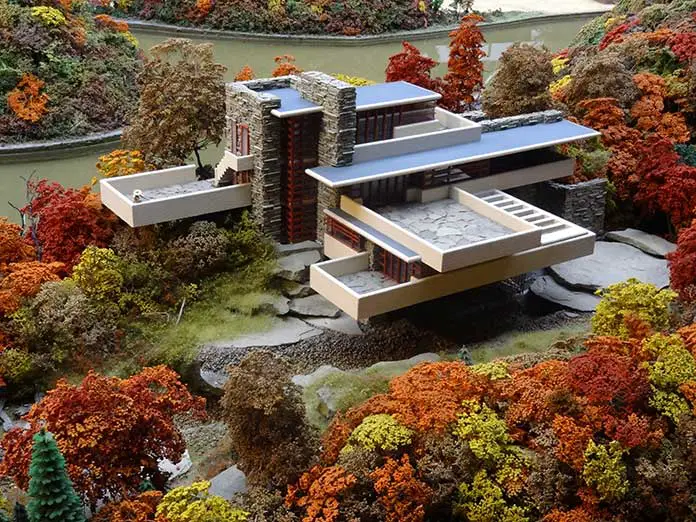
While its form is distinct and standout, Fallingwater was designed for a family to live in and among nature. Fallingwater is a 20th-century masterpiece in organic architecture—one that was created nearly four decades before the design world began to consider its impact on the planet. Fallingwater is known as one of the “best all-time works of American architecture” by the American Institute of Architects.
What materials is Fallingwater made of?
By the time Wright was commissioned for Fallingwater, he was already 67 years old with very few commissions, as his prime overlapped with the Great Depression. When he was born, his mother accurately proclaimed that as her firstborn child, he would grow up to build magnificent buildings. She even went as far as decorating his nursery with drawings of cathedrals. Fallingwater, a tribute to the harmonious relationship between form and function, civilization and nature. In 1935, Wright was commissioned by the Kaufmanns, a prominent Pennsylvanian family, to replace their deteriorating summer home. Nestled along a stream in Bear Run, an Appalachian reserve, this property was a perfect fit for Wright, whose nature-inspired approach had attracted Edgar and Liliane Kaufmann.
Learn From Top Artists
The second is his Usonian houses, an urban planning concept for ideal living that consisted of neighborhoods of small L-shaped abodes with a strong indoor-outdoor connection. Concurrently with the design of Fallingwater, Wright was exploring designs for the Usonia house. Later, in the 1950s, he would plan America’s only district of such homes in Pleasantville, New York.

Fallingwater: Exterior and Interior
Fallingwater proved that Wright was not an outdated architect ready for retirement but an enduring visionary ready for the next phase of his career. Some of his most high-profile commissions came after, including the Guggenheim Museum in New York City. The Kaufmanns continued to reside in Fallingwater but quickly noticed that the main terrace was beginning to sag, later recognized as the result of Wright’s refusal to use additional steel despite his contractor’s suggestions. The terraces form a complex, overriding horizontal force with their protrusions that liberated space with their risen planes parallel to the ground. In order to support them, Wright worked with engineers Mendel Glickman and William Wesley Peters.
On the left is a “wine ball”, a red, spherical container fitted with a handle on a hinge, that allows you to place it over the fire to heat the drink inside. The one on the East side is next to a small exterior staircase which leads to the terrace of the Kaufmann’s son’s bedroom. To the left of the chimney, a door leads to the kitchen; a smaller room than the living room with furniture exclusively designed by Wright for the house, as was the case for the rest of the furniture also. Between the door to the kitchen and the staircase is the dining table, placed against the North wall of the dining room. Each level is marked by wide projections which protrude asymmetrically in various directions. The exterior of the house maintains an intimate relationship with the surrounding nature.
Falling Water is just 50 minutes away from us. We are a perfect location to stay.
Above the sofa area of the living room, there is the master bedroom, which has a small bathroom and an expansive terrace, which extends, cantilevered towards the South. In this room there is a bed and a staircase which leads to the viewpoint above the second floor. In the last room there is a window which extends down to the kitchen below.
Kaufmann found this extravagant, however, and eventually the concrete surfaces were painted a beige color. After completing the 9,300-square-foot main house (4,400 square feet of which are the outdoor terraces), Wright designed an additional 4,990-square-foot guest house. The Kaufmanns lived in La Tourelle, a French Norman estate in Fox Chapel designed in 1923 by Pittsburgh architect Benno Janssen. However, the family also owned a remote property outside Pittsburgh—a small cabin near a waterfall—which was used as a summer retreat.
After touring, continue south on this same road until you reach Route 40 again. Fallingwater reserves the right to restrict photography at any time in any location. Fallingwater staff have the authority to approach and verify the intent of photography to ensure compliance with the photography policy. Failure to adhere to these guidelines or staff direction may result in being asked to cease all photography or leave the premises.
Visiting Fallingwater
Along with your exploration of the house and landscape, consider an additional experience to further enjoy your time at Fallingwater. This building, constructed over three levels, sits on a rock over a natural waterfall. We offer you extensive information about the history of art, analyses of famous artworks, artist biopics, information on architecture, literature, photography, painting, and drawing. Although not initially very interested in the material, the flexibility of it and the tensile strength that it provided when combined with reinforced steel made him change his mind.
Using resources directly from the quarry and building the house directly on top of a waterfall, Frank Lloyd Wright succeeded in making the most out of nature while building. Through the feature, teachers can link to websites that give a biographical overview of the famous architect and his preference for architectural styles that reflect America’s democratic values and ideals. Or use interactive animation to learn more about construction forces and cantilevers . Now a museum, the site welcomes eager architectural fans from all over the world. Featuring a range of tours tailored to visitors' interests, exploring Fallingwater firsthand is an ideal way to appreciate this great blessing.
On the House: Iconic Wright house fascinating but not a home - The Columbus Dispatch
On the House: Iconic Wright house fascinating but not a home.
Posted: Sun, 15 Apr 2018 07:00:00 GMT [source]
On any trip to Deep Creek Lake, we always suggest taking a road trip to visit Fallingwater and other nearby Frank Lloyd Wright designs. As always, when you’re planning the activities for your vacation, start the day with our hearty breakfast. You’ll be fully caffeinated and satiated before you hit the road for this gorgeous drive through the scenic Laurel Highlands. As a guest at our Deep Creek Hotel, you’ll be just under an hours scenic drive to Fallingwater.
Wright was born in Wisconsin on the 8th of June 1867, although he sometimes claimed that he was born in 1869. From its daring cantilevers to its corner window detail and constant sound of the waterfall, Fallingwater is the physical and spiritual occurence of man and architecture in harmony with nature. Wright's admiration for Japanese architecture was important in his inspiration for this house, along with most of his work. Just like in Japanese architecture, Wright wanted to create harmony between man and nature, and his integration of the house with the waterfall was successful in doing so.




No comments:
Post a Comment