Table Of Content
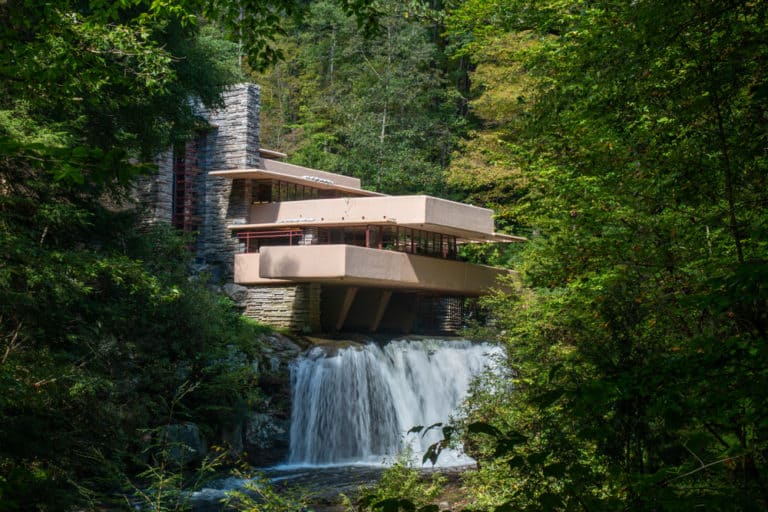
From each window of our luxury hotel you’ll take in a beautiful scene, from the sparkling water of Deep Creek Lake to the blooming perennials in our gardens. There’s also no better place than our Deep Creek Lake Hotel to head back to after a chilly day exploring the sights of our beautiful part of the Northeast. We’ll be ready to welcome you back with a hot chocolate and a warm fire in the living room. The ancient Red and White Oaks, American Sycamores and Beech trees really shine in this season.
Photo Gallery of Falling Water, a Frank Lloyd Wright Design
Along with your exploration of the house and landscape, consider an additional experience to further enjoy your time at Fallingwater. This building, constructed over three levels, sits on a rock over a natural waterfall. We offer you extensive information about the history of art, analyses of famous artworks, artist biopics, information on architecture, literature, photography, painting, and drawing. Although not initially very interested in the material, the flexibility of it and the tensile strength that it provided when combined with reinforced steel made him change his mind.
Falling Water & Frank Lloyd Wright
Fallingwater proved that Wright was not an outdated architect ready for retirement but an enduring visionary ready for the next phase of his career. Some of his most high-profile commissions came after, including the Guggenheim Museum in New York City. The Kaufmanns continued to reside in Fallingwater but quickly noticed that the main terrace was beginning to sag, later recognized as the result of Wright’s refusal to use additional steel despite his contractor’s suggestions. The terraces form a complex, overriding horizontal force with their protrusions that liberated space with their risen planes parallel to the ground. In order to support them, Wright worked with engineers Mendel Glickman and William Wesley Peters.

Western Pennsylvania Conservancy
Though Fallingwater was designed as a private home for the Kaufmann family, it is now unoccupied to allow architecture aficionados from around the globe to explore its interior and exterior, all carefully designed by Frank Lloyd Wright. According to the Western Pennsylvania Conservancy that protects and operates the house, more than 6.4 million visitors have visited Fallingwater since it opened as a public museum in 1964. While this landform may have dictated—in Wright’s mind—the obvious building site, its massing and material palette were entirely his invention. The horizontal orientation of the home’s large terraces (which are enclosed by parapets) recalls two of Wright’s prior residential architecture explorations. The first is prairie-style architecture, which was inspired by the flatlands of the American Midwest, where Wright was born and raised.
The design of Fallingwater was proof that he was still a relevant architect, and even ahead of his time. Other famous buildings that were commissioned to Wright after Fallingwater included the Guggenheim Museum in New York. Throughout his career, Wright designed around 800 buildings, which is a staggering amount, considering how late his professional career peaked. The history of Fallingwater plays a very big role in Wright’s architectural career, as the uniqueness of the waterfall house resulted in international fame and proved that he was more than relevant. The majority of the house’s structure is made of concrete, with exposed columns and beams forming porticos and the projections (the horizontal elements which extend as terraces over the waterfall) all made of concrete.
Wright was born in Wisconsin on the 8th of June 1867, although he sometimes claimed that he was born in 1869. From its daring cantilevers to its corner window detail and constant sound of the waterfall, Fallingwater is the physical and spiritual occurence of man and architecture in harmony with nature. Wright's admiration for Japanese architecture was important in his inspiration for this house, along with most of his work. Just like in Japanese architecture, Wright wanted to create harmony between man and nature, and his integration of the house with the waterfall was successful in doing so.
Wright at Polymath Park tour times vary throughout the season, so we invite you to explore individual tour options for availability. In the interior of the Fallingwater House we find rooms which are unique in their distribution, location and finishes. Wright entrusted the Gillian Woodworking Corporation with the Manufacturing of most of these furniture pieces.
Wright and Fallingwater
Fallingwater is a house designed by the architect Frank Lloyd Wright in 1935. Situated in the Mill Run section of Stewart township, in the Laurel Highlands of southwest Pennsylvania, about 70 miles (110 km) southeast of Pittsburgh in the United States,[4] it is built partly over a waterfall on the Bear Run river. The house was designed to serve as a weekend retreat for Liliane and Edgar J. Kaufmann, the owner of Pittsburgh's Kaufmann's Department Store. These warm colors are a stark contrast to the neutral palette of the rest of the house, but it adds a certain warmth and coziness against the cold stone floors.
Spaces
The second is his Usonian houses, an urban planning concept for ideal living that consisted of neighborhoods of small L-shaped abodes with a strong indoor-outdoor connection. Concurrently with the design of Fallingwater, Wright was exploring designs for the Usonia house. Later, in the 1950s, he would plan America’s only district of such homes in Pleasantville, New York.
Using resources directly from the quarry and building the house directly on top of a waterfall, Frank Lloyd Wright succeeded in making the most out of nature while building. Through the feature, teachers can link to websites that give a biographical overview of the famous architect and his preference for architectural styles that reflect America’s democratic values and ideals. Or use interactive animation to learn more about construction forces and cantilevers . Now a museum, the site welcomes eager architectural fans from all over the world. Featuring a range of tours tailored to visitors' interests, exploring Fallingwater firsthand is an ideal way to appreciate this great blessing.
The Waterfall House / Greenbox Design - ArchDaily
The Waterfall House / Greenbox Design.
Posted: Thu, 11 Apr 2024 07:00:00 GMT [source]
However, when the home was constructed in 1935, it cost the Kaufmanns $148,000 to construct, and they paid Wright an additional $11,800 in architectural design fees. Accounting for today’s inflation, the project’s construction would have racked up a price of $3.3 million, and Wright would have brought in $264,445 as its architect. UNESCO considers the international importance of a potential World Heritage Site based on its “Outstanding Universal Value,” which in the Wright series is manifested in three attributes. First, it is an architecture responsive to functional and emotional needs, achieved through geometric abstraction and spatial manipulation. Second, the design of the buildings in this series is fundamentally rooted in nature’s forms and principles.
While its form is distinct and standout, Fallingwater was designed for a family to live in and among nature. Fallingwater is a 20th-century masterpiece in organic architecture—one that was created nearly four decades before the design world began to consider its impact on the planet. Fallingwater is known as one of the “best all-time works of American architecture” by the American Institute of Architects.
What's in the basement at Fallingwater? - NEXTpittsburgh
What's in the basement at Fallingwater?.
Posted: Mon, 17 Jul 2023 07:00:00 GMT [source]
Wright’s design suspended the home above the fall itself, filling the interiors with the powerful sound of rushing water. Fallingwater is a program of the Western Pennsylvania Conservancy.The Conservancy is a nonprofit, tax-exempt charitable organization underSection 501(c)(3) of the Internal Revenue Code, and 100% of your donationis tax-deductible as allowed by law. Participate in immersive and innovative programs that explore the intersection of art, nature and design. These eight sites have played a prominent role in the development and evolution of modern architecture during the first half of the 20th century and continuing to the present. To visit Kentuck Knob, return to Ohiopyle and after just crossing over the bridge, take your immediate right onto Ohiopyle Road.
On the ground of the terrace outside Mr. Kaufmann’s office, two holes were intended to be left so that the trees could pass through them. However, as the trees died during the construction of the house, no such apertures were made. The Fallingwater house is a symbol of how humans can live in harmony with their environment, instead of only using nature as an accessory or a secondary view.




No comments:
Post a Comment